
Introduction
Underwater Surveys play a critical role in maintaining bridges, ports, and marine infrastructure. Many structural problems develop below the waterline, where visual inspections from the surface cannot detect them. According to the American Society of Civil Engineers, over 42,000 bridges in the United States are rated in poor condition, making regular inspections essential for safety and long-term performance.
Modern marine infrastructure faces constant exposure to currents, corrosion, vessel impacts, and sediment movement. These factors gradually weaken foundations and supporting elements. Through detailed inspections, underwater specialists identify damage before it becomes a major structural issue.
We have seen maintenance teams save significant repair costs by detecting erosion, scour, and concrete deterioration early. In many cases, minor repairs completed after an inspection prevent expensive emergency interventions later.
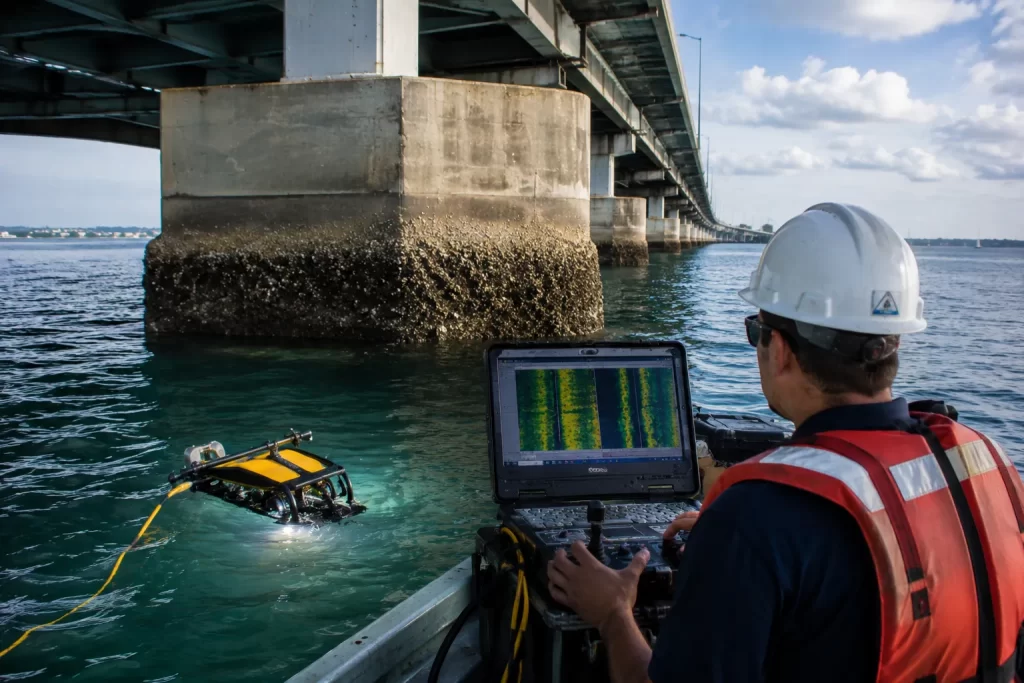
Today, advanced sonar systems, remotely operated vehicles (ROVs), and professional dive teams make underwater assessments more accurate than ever. These technologies provide detailed information about submerged structures, helping engineers make informed maintenance decisions. As infrastructure ages and maritime traffic increases, Underwater Surveys have become an essential component of bridge and port asset management.
Why Underwater Surveys Are Essential for Infrastructure Safety
Detecting Hidden Structural Damage
Underwater Surveys reveal structural issues that remain invisible during standard inspections. Bridge piers, seawalls, piles, and port foundations are constantly exposed to harsh underwater conditions. Over time, corrosion, cracking, and material loss can compromise structural integrity.
Survey teams use high-resolution imaging and sonar equipment to inspect submerged components. These technologies identify defects with remarkable accuracy. Engineers can then evaluate risks and prioritize repairs before failures occur.
Scour is one of the leading causes of bridge collapse in the United States. The Federal Highway Administration reports that approximately 60% of bridge failures result from scour and foundation instability. Regular underwater inspections help identify erosion around foundations before it threatens structural stability.
Key safety benefits include:
- Early detection of corrosion.
- Identification of scour around foundations.
- Monitoring of structural movement.
- Assessment of underwater concrete conditions.
- Evaluation of vessel impact damage.
These inspections provide critical information that improves infrastructure reliability and public safety.
How Underwater Surveys Support Port Maintenance Programs
Improving Operational Efficiency
Ports handle millions of tons of cargo annually and depend on reliable infrastructure. Underwater Surveys help port authorities maintain docks, berths, quay walls, and navigation channels without disrupting operations.
Survey data allows maintenance teams to identify deterioration before it affects vessel traffic. Regular inspections reduce the risk of unexpected closures and costly emergency repairs. This proactive approach improves operational continuity and extends asset lifespan.
Modern surveys often combine diver inspections with multibeam sonar mapping. This combination provides a comprehensive view of underwater conditions. Engineers can compare historical survey results to monitor structural changes over time.
| Survey Type | Primary Purpose | Typical Frequency |
|---|---|---|
| Visual Diver Inspection | Structural assessment | Annually |
| Sonar Mapping | Seabed analysis | Every 1–2 years |
| ROV Inspection | Detailed imaging | As needed |
| Scour Survey | Foundation stability | After major storms |
| Sediment Survey | Navigation maintenance | Quarterly |
Port operators use this information to schedule maintenance efficiently while minimizing downtime and operational disruptions.
Technologies Used in Modern Underwater Surveys
Advanced Tools Deliver Better Results
Technological advances have transformed the accuracy of Underwater Surveys. Traditional diver inspections remain valuable, but modern equipment provides more detailed and measurable data.
Remotely Operated Vehicles allow inspections in hazardous or deep-water environments. These systems capture high-definition video and collect structural measurements without exposing divers to unnecessary risks.
Multibeam sonar creates precise three-dimensional maps of underwater structures and seabeds. Engineers use these maps to identify scour holes, sediment buildup, and structural deformation. Side-scan sonar helps locate debris, obstructions, and damaged infrastructure components.
Common technologies include:
- Remotely Operated Vehicles (ROVs).
- Multibeam sonar systems.
- Side-scan sonar imaging.
- Underwater laser scanning.
- GPS positioning systems.
- High-definition underwater cameras.
Industry experts increasingly recommend combining multiple technologies during inspections. This approach improves data accuracy and provides a more complete assessment of structural conditions.
Long-Term Benefits of Regular Underwater Surveys
Extending Infrastructure Service Life
Regular Underwater Surveys support predictive maintenance strategies that reduce lifecycle costs. Identifying problems early allows asset owners to make targeted repairs before damage spreads.
Bridge and port infrastructure often represent investments worth hundreds of millions of dollars. Protecting these assets requires continuous monitoring and informed decision-making. Survey findings help engineers prioritize maintenance budgets based on actual structural conditions.
Our experience shows that facilities conducting routine underwater inspections experience fewer emergency repairs and lower maintenance costs over time. Consistent monitoring also improves regulatory compliance and supports risk management programs.
Long-term advantages include:
- Reduced repair expenses.
- Improved public safety.
- Extended infrastructure lifespan.
- Better maintenance planning.
- Enhanced regulatory compliance.
- Lower operational risks.
These benefits make underwater inspection programs a valuable investment for both public and private infrastructure owners. Explore our solutions for Underwater Surveys.
Conclusion
Underwater Surveys provide essential information for maintaining bridges, ports, and other marine structures. They uncover hidden damage, monitor foundation stability, and support informed maintenance planning. Modern technologies such as ROVs, sonar systems, and underwater imaging have significantly improved inspection accuracy and efficiency.
As infrastructure continues to age, proactive maintenance becomes increasingly important. Regular underwater inspections help prevent costly failures, extend service life, and improve operational reliability. By identifying issues before they escalate, asset owners can protect critical infrastructure while maintaining safety and performance. For bridges and ports that depend on strong underwater foundations, comprehensive survey programs remain one of the most effective tools for long-term asset management.